What Is Acne Scarring?
Acne scarring is the term used to describe the permanent or long-lasting changes to the skin that follow the resolution of inflamed acne lesions. It is one of the most common concerns seen in aesthetic practice and one of the more challenging to address, because the changes involve structural alterations within the dermis rather than simply the surface of the skin.
Not all marks left by acne are true scars. Post-inflammatory hyperpigmentation, the flat areas of redness or darkened discolouration that persist after a spot has healed, is not a structural change and has a better prognosis with treatment. True scars, whether atrophic (involving tissue loss) or hypertrophic (involving excess fibrous tissue), represent permanent alterations to the dermal architecture. This distinction matters because it directly shapes what treatment approaches are appropriate and what outcomes are realistic.
The impact of acne scarring on self-confidence and quality of life is well documented and should not be minimised. Many people who experienced acne years or even decades previously continue to be affected by residual scarring, and this is a legitimate and treatable concern. At Regener8 Aesthetics in Selly Oak, Birmingham, the aim is to provide an honest assessment of your scarring, explain the treatment options that are supported by evidence, and work with you towards the most meaningful improvement achievable.
Acne scarring results from disrupted wound healing during the resolution of inflamed acne lesions. When the inflammatory process damages the dermis, the skin's repair response may either fail to produce sufficient collagen (leading to atrophic, depressed scarring) or produce excess fibrous tissue (leading to hypertrophic or keloid scarring). The most common form seen in clinical practice is atrophic scarring, which encompasses icepick, boxcar, and rolling subtypes.
Types of Acne Scarring
Acne scarring is not a single entity. Identifying the type or types of scarring present is the first step in selecting appropriate treatment, as different subtypes respond differently to different interventions.
Atrophic Scars
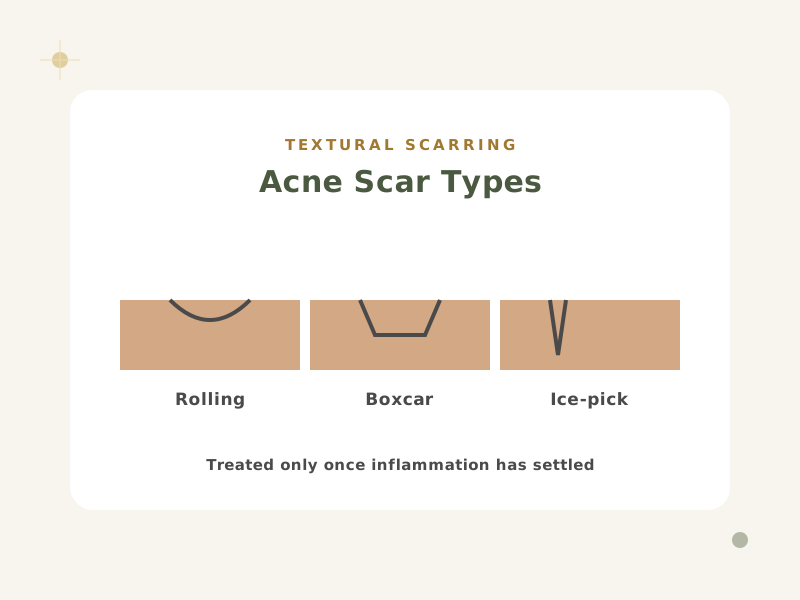
Atrophic scars are the most common type and are caused by a net loss of collagen during the healing process. They appear as depressions or indentations in the skin surface. There are three recognised subtypes:
- Icepick scars: narrow, deep pits that extend into the dermis. They appear as small, sharp puncture-like holes and are the most difficult subtype to treat due to their depth relative to their width. They are most common on the cheeks.
- Boxcar scars: broader depressions with well-defined, steep or vertical edges. They resemble the marks left by chickenpox and vary in depth. Shallower boxcar scars respond better to treatment than deeper ones.
- Rolling scars: broad, shallow depressions with sloping, indistinct edges that give the skin an undulating or wavy appearance. They are caused by fibrous bands tethering the skin surface to deeper tissue and can respond well to collagen induction therapy.
Hypertrophic and Keloid Scars
These are raised scars caused by an excess of fibrous tissue production during healing. Hypertrophic scars remain within the boundaries of the original lesion; keloid scars extend beyond it. They are less common in acne than atrophic scars and are more frequently seen on the chest, back, and shoulders. People with darker skin tones have a higher predisposition to keloid formation. These scar types may require specialist dermatology or plastic surgery input rather than standard aesthetic treatment.
Post-Inflammatory Hyperpigmentation
Post-inflammatory hyperpigmentation (PIH) is not technically a scar but is often grouped with acne scarring in everyday language because it follows the same inflammatory trigger. It presents as flat areas of pink, red, brown, or dark brown discolouration depending on skin tone. PIH can last for months to years without targeted treatment but does not involve structural changes to the dermis. It tends to respond well to chemical peels, topical brightening agents, and meticulous sun protection.
How Acne Scars Form
When an acne lesion becomes inflamed, the body launches a wound healing response within the dermis. In ideal circumstances this process is well regulated, producing enough collagen to restore the dermis to its original structure. In practice, this regulation can fail in either direction: insufficient collagen production leads to atrophic scarring, while excessive fibroblast activity and collagen deposition leads to hypertrophic or keloid scarring.
The risk of scarring increases with the severity and depth of the acne lesion. Nodular and cystic acne, which cause extensive dermal damage, are most likely to result in significant scarring. However, even papular and pustular acne can leave marks, particularly if lesions are frequently manipulated. Picking, squeezing, or attempting to extract lesions forcibly introduces additional trauma and bacteria into the dermis, increasing the depth and extent of inflammation and therefore the likelihood of scarring.
The time taken for active acne to be brought under control also matters. Prolonged periods of uncontrolled, recurrent inflammatory acne expose the dermis to repeated injury in the same areas, compounding dermal damage and increasing the risk of cumulative scarring. This is one of the clearest arguments for addressing active acne promptly and effectively, whether through medical or combined medical and aesthetic management.
Active acne must be adequately controlled before scar treatment begins. Treating scars whilst new inflammatory lesions are forming risks creating further damage and can interfere with the healing processes that scar remodelling relies upon. Establishing stable skin management first produces better scar treatment outcomes.
Who Is Affected?
Acne scarring can affect anyone who has experienced inflammatory acne, regardless of age, gender, or skin tone. Studies suggest that scarring of some degree is present in a significant proportion of people who have had moderate to severe acne, though the extent and pattern varies considerably between individuals.
Certain factors increase the likelihood of scarring. These include a delay in treating active acne effectively, a history of particularly severe or deep inflammatory lesions, a habit of manipulating or picking at spots, a family history of scarring (suggesting a genetic component to wound healing response), and the presence of conditions that slow healing, such as poorly controlled diabetes.
Skin tone is a significant variable, both in terms of scarring risk and in terms of how scarring presents and responds to treatment. People with darker skin tones are more prone to post-inflammatory hyperpigmentation and keloid formation. They also require more carefully calibrated treatment protocols to avoid treatment-induced hyperpigmentation. This is not a reason to avoid treatment but a reason to ensure assessment and planning are thorough and skin-tone-aware. At Regener8 Aesthetics, Fitzpatrick skin classification is an integral part of every consultation for skin conditions and scarring.
The emotional burden of acne scarring is real and does not diminish simply because the acne itself has resolved. People carry the visible evidence of a condition they may have struggled with for years, and this deserves acknowledgement alongside the clinical assessment.
Diagnosis and Assessment
Assessment of acne scarring begins with identifying the types of scars present, their distribution, depth, and the degree to which post-inflammatory hyperpigmentation contributes to the overall picture. Distinguishing between atrophic subtypes matters for treatment selection: rolling scars, for example, respond differently to microneedling than icepick scars, and the treatment plan should reflect this.
Fitzpatrick skin type is assessed at the outset. This determines which treatments can be used safely, at what intensity, and with what precautions. People with Fitzpatrick IV to VI skin types benefit from a more cautious, step-wise approach to avoid the risk of treatment-induced post-inflammatory hyperpigmentation. Patch testing before chemical peels is essential for those with reactive skin or darker skin tones.
The current status of active acne is also evaluated. If significant active acne is still present, the priority discussion is around bringing this under control first, which may involve a conversation about GP or dermatology referral for medical management. Scar treatment is best positioned once the skin is in a stable, largely non-inflammatory state.
At the consultation at Regener8 Aesthetics in Birmingham, the assessment covers all of these factors alongside your skin history, previous treatments, and your goals for improvement. The starting point is always a clear and honest conversation about what is achievable and over what timeframe.
Evidence-Based Treatments
Acne scar treatment typically requires a course of sessions rather than a single treatment, and realistic expectations centre on meaningful improvement rather than complete elimination. Multiple sessions allow the cumulative dermal remodelling that produces lasting results.
Microneedling, Collagen Induction Therapy
Microneedling is the most widely used and well-evidenced aesthetic treatment for atrophic acne scarring. Fine needles create controlled micro-channels in the skin at a calibrated depth, triggering the skin's wound healing cascade without causing the same type of dermal damage that created the scars in the first place. This stimulates fibroblast activity and new collagen and elastin production, gradually remodelling the scar tissue from within.
Rolling and boxcar scars tend to respond best to microneedling. Icepick scars, due to their narrow depth, are more resistant and may require additional techniques such as punch excision at dermatology level for significant improvement. A typical course for acne scarring at Regener8 Aesthetics involves three to six sessions spaced four to six weeks apart, with results continuing to develop for three to six months after the final session as new collagen matures. Topical numbing cream is applied before each session.
PRP Combined with Microneedling
Platelet-Rich Plasma therapy, when combined with microneedling, delivers concentrated growth factors from the patient's own blood directly into the micro-channels created by the needles. This amplifies the collagen induction stimulus and may accelerate and enhance the dermal remodelling process. Clinical evidence supports the combination as producing better outcomes for atrophic scarring than microneedling alone in many patients. The procedure is well tolerated and uses the patient's own biological material, reducing the risk of adverse reactions. At Regener8 Aesthetics, combined PRP and microneedling is offered for those with moderate to significant atrophic scarring.
Chemical Peels
Chemical peels are most relevant for the surface-level manifestations of acne scarring, particularly post-inflammatory hyperpigmentation and mild surface texture irregularities. Glycolic and lactic acid peels improve epidermal turnover and lighten PIH marks. Trichloroacetic acid (TCA) peels at medium depth can address more established surface changes and some shallow boxcar scarring. Peels require patch testing before the first session, particularly for clients with darker skin tones, and consistent use of high-factor sun protection throughout any peel course is non-negotiable. Peels and microneedling are often used in a complementary sequence.
Profhilo and Jalupro
Injectable biostimulators such as Profhilo and Jalupro support the skin's extracellular matrix and improve overall skin quality, hydration, and elasticity. They are not primary treatments for structural scarring but can improve the overall quality and resilience of scar-affected skin, making it a better foundation for other treatments and for cosmetic appearance. They may be considered as part of a longer-term skin health plan rather than as a standalone scar intervention.
Managing Expectations
A realistic expectation for a well-delivered course of microneedling, with or without PRP, is an improvement in scar appearance in the range of 30 to 70 percent. This is a meaningful and often life-changing improvement for those who have lived with significant scarring, but it is not elimination. The degree of improvement depends on scar type, depth, skin tone, skin health, the number of sessions completed, and individual healing responses. These nuances are discussed fully at consultation so that any treatment plan is built on a clear and honest foundation.
Book a £25 consultation at Regener8 Aesthetics in Selly Oak, Birmingham. The fee is fully redeemable against any treatment booked within 30 days. No pressure to proceed. Consultations available in English, Farsi and Russian.
Finance available, subject to approval, via our Payl8r finance partner.
Why Choose Regener8 Aesthetics?
Honest assessment from the outset. Acne scarring is an area where unrealistic promises are common. At Regener8 Aesthetics, the approach is to be straightforward about scar types, what each treatment can achieve, how many sessions are typically needed, and where the limits of aesthetic treatment lie. Informed clients make better decisions and have better experiences.
Skin tone-aware practice. The assessment, treatment selection, and calibration of procedures at Regener8 takes Fitzpatrick skin classification fully into account. This is not an afterthought but a fundamental part of the consultation process, ensuring that every client receives a treatment plan that is appropriate and safe for their individual skin.
Clinical healthcare background. Our lead practitioner brings a clinical healthcare background that shapes both the standard of technical delivery and the quality of the consultation. Knowing when to refer to dermatology or plastic surgery for cases that fall outside the appropriate scope of aesthetic practice is as important as the treatments themselves.
Unhurried, thorough consultations. Acne scarring often carries a significant emotional history. Consultations at the Selly Oak clinic are structured to allow proper time for assessment, conversation, and questions. Clients across Birmingham and the wider West Midlands leave with a clear understanding of the plan and realistic expectations of the journey ahead.
Multilingual consultations. Regener8 Aesthetics offers consultations in English, Farsi, and Russian. Discussing something as personal as scarring is more straightforward when language is not a barrier, and the clinic is committed to ensuring every client feels properly heard and understood.
- Acne scarring encompasses atrophic scars (icepick, boxcar, rolling), hypertrophic or keloid scars, and post-inflammatory hyperpigmentation, each type responds differently to treatment.
- Microneedling (collagen induction therapy) is the primary evidence-based aesthetic treatment for atrophic scarring, with rolling and boxcar scars responding best.
- PRP combined with microneedling enhances dermal remodelling and may improve outcomes compared with microneedling alone for moderate to significant atrophic scarring.
- Active acne should be under reasonable control before scar treatment begins; treating scars alongside ongoing inflammatory acne reduces treatment effectiveness and risks further damage.
- Realistic expectations are 30 to 70% improvement over a course of sessions, meaningful and significant for most people, but not elimination; honest expectation-setting is central to every consultation.